10 Career Mistakes That Keep Smart Professionals Stuck
Mar 22, 2026
Most people are not stuck because they lack ability, ambition, or intelligence. They are stuck because of a series of subtle decisions that shape their career over time, decisions that feel reasonable in the moment but compound in ways that hold them back.
And if I am being honest, choosing not to take the lead in your career is also a decision.
In this episode, I walk you through ten of the most common career mistakes I see in capable, driven professionals, along with simple, practical ways to start thinking differently about each one.
What you will take away from this episode:
- Why working hard is not always enough to move your career forward
- How loyalty, comfort, and “doing the right thing” can sometimes slow your growth
- The difference between moving forward and moving in the right direction
- Why visibility and positioning matter more than most people realise
- How to start making more intentional, aligned career decisions
The mistakes we explore are often subtle, but they have a significant impact over time.
The goal is not to avoid every mistake. Careers are long and rarely linear, and you will make decisions that, in hindsight, you might approach differently. That is part of the process.
What matters is becoming more aware, because when you step back and start asking better questions, you naturally begin to make better decisions. Instead of reacting to opportunities, you start choosing them. Instead of drifting, you start designing, and that is where everything changes.
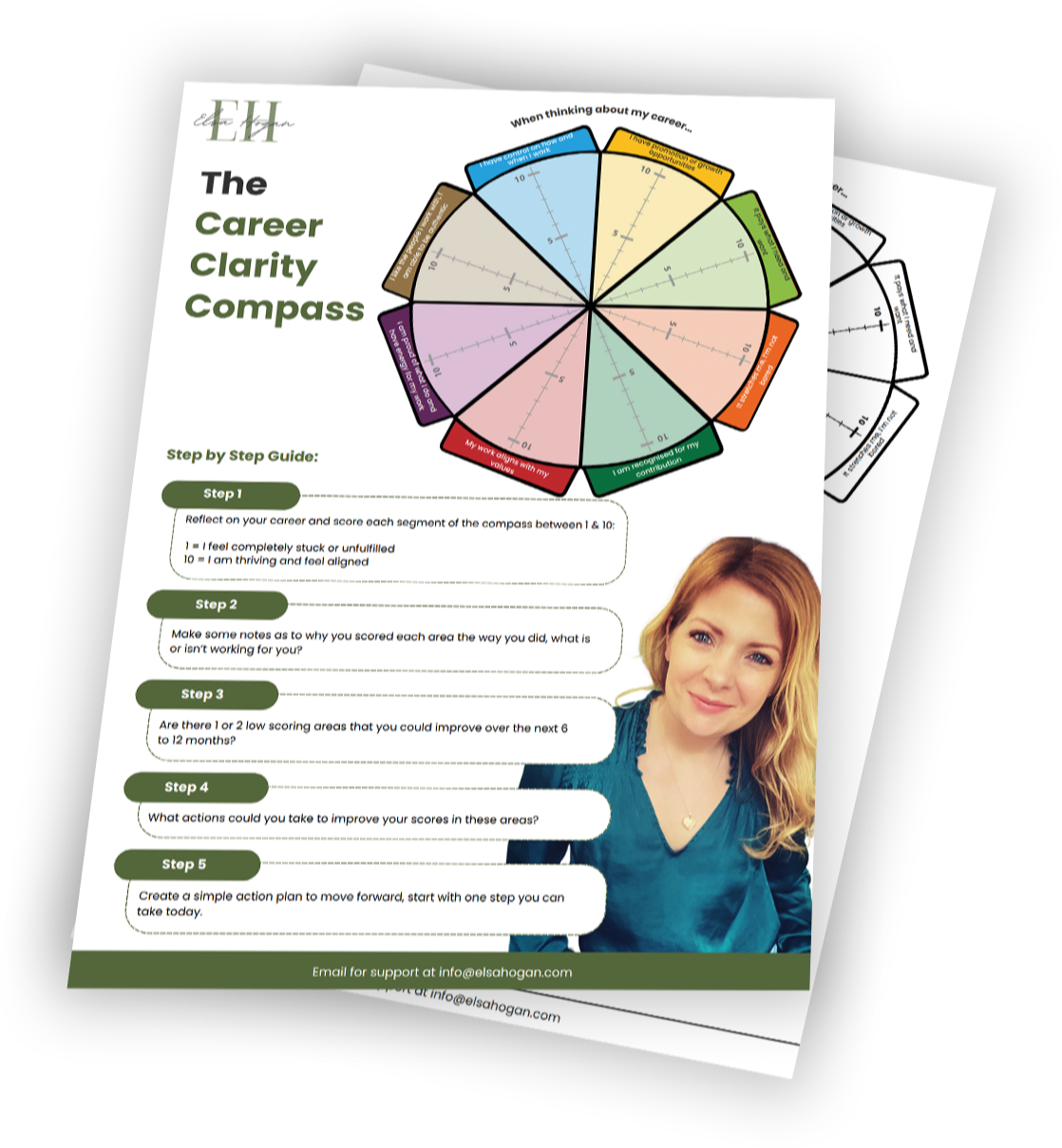
If this episode resonated with you, a powerful place to start is by stepping back and looking at your career more holistically.
If you found this helpful, make sure you follow the podcast on Spotify so you are first to find out when new episodes are released.
Always with love,
Elsa x
Transcript
When you start designing your career rather than drifting through it, something really interesting happens. Your choices become clearer, your energy becomes focused, and the path forward starts to feel far more aligned with the life that you want to build.
Hello and welcome to Career Clarity Insights. I’m Elsa Hogan, and this is where I share reflections and practical ideas to help you build a career and life that you love.
Let’s jump in.
Today we are talking about something that I see all the time in coaching conversations, and that is incredibly capable, intelligent people making career decisions that hold them back.
So today, I want to walk you through ten of the most common career mistakes I see smart professionals make, and hopefully help you spot any that might be shaping your own career decisions.
Mistake number one is waiting to be recognised.
Many people assume that if they work hard and deliver good results, someone will eventually notice and open the next door for them. And sometimes this happens, but very often it does not.
Careers rarely move forward through effort alone, and visibility really does matter. Doing great work is the foundation, but people also need to understand the value that you bring.
A simple action you can take is to start sharing your work more intentionally. That might mean updating your manager regularly on progress, speaking up in meetings, or volunteering to present results.
This is not about being boastful, but about helping people see the impact you are having. It needs to be authentic, relevant, and appropriate for your audience.
Mistake number two is staying loyal for too long.
Loyalty can be a wonderful trait, but in some careers it can also become a trap. Many people stay in roles long after they have stopped growing or adding value because they feel responsible to their team or grateful to their organisation.
Growth matters. If you are no longer developing new capabilities or expanding your impact, loyalty may be costing you more than you realise.
A useful question to ask yourself is: what am I learning here that I could not learn somewhere else? If the answer becomes unclear, it might be time to explore new opportunities, either within your organisation or beyond.
Mistake number three is thinking one promotion at a time.
A lot of people plan their careers step by step, focusing only on the next role or the next performance review. But very few people step back and ask a bigger question: where do I want to be in ten years’ time?
Without that bigger perspective, it is easy to move without direction. Movement is not the same as alignment.
Even if you do not know exactly what you want, you can start by asking how you want your career to feel. What kind of impact do you want to have? What problems do you want to solve? What kind of life do you want to build?
From there, you can begin working backwards.
Mistake number four is avoiding visibility.
Many people believe that great work should speak for itself. In reality, leaders make decisions based on what they can see, and if your work is invisible, your impact becomes invisible too.
This does not mean self-promotion in an uncomfortable way. It means ensuring that the right people understand what you are doing and the value you bring.
Small moments of visibility can have a big impact, especially when decisions involve multiple stakeholders. Even one positive interaction can influence how your contribution is perceived.
Mistake number five is staying too comfortable.
Comfort can stall your career. When your role becomes too easy or predictable, it can feel good in the short term, but over time it stops stretching you.
Growth usually happens just outside your comfort zone. Not so far that it causes constant stress, but enough to challenge and develop you.
Ask yourself: what am I doing today that felt difficult a year ago? If nothing comes to mind, it may be time to seek out new challenges.
Mistake number six is only developing technical skills.
Early in your career, technical competence is often what gets rewarded. But as you progress, other skills become more important, such as strategic thinking, communication, influence, and commercial awareness.
Many people remain strong technically but do not intentionally develop these broader capabilities.
If you want to move into more senior roles, look for opportunities to build these skills. That could mean leading cross-functional projects, presenting to senior stakeholders, or taking on mentoring or coaching roles.
Mistake number seven is ignoring the business model.
This is more common than you might think. People can spend years in an organisation without fully understanding how it makes money.
Understanding revenue, costs, customers, and commercial drivers strengthens your ability to think strategically and contribute at a higher level.
Start by asking simple questions. How does the business generate revenue? What are the biggest costs? Who are the most important customers?
Even a basic understanding can transform your perspective.
Mistake number eight is waiting until you feel ready.
Confidence often does not come before action. In most cases, people grow into roles rather than feeling fully prepared from the start.
If you wait until you feel completely ready, you may end up waiting far longer than necessary.
Instead, reframe stretch opportunities as learning opportunities. If something feels slightly beyond your current capability, ask yourself whether you could figure it out with support and effort.
Often, the answer is yes.
Mistake number nine is building a career around expectations.
Many careers are shaped by what other people expect, rather than what actually energises and fulfils you.
Over time, this can lead to a career that looks impressive on paper but feels disconnected from what you truly want.
Take time to define success on your own terms. What does a fulfilling career look like for you?
The more clarity you have, the easier it becomes to make aligned decisions.
Mistake number ten is drifting instead of designing.
This is one of the biggest patterns I see. Many careers are shaped by opportunities that simply appear, rather than intentional choices.
A role opens up, a manager suggests something, and before you know it, years have passed without a clear direction.
One of the most powerful things you can do is pause and ask yourself: what am I actually building towards?
If the answer is unclear, it might be time to step back and start designing your next chapter more intentionally.
You may have recognised yourself in one or more of these mistakes, and that is completely normal. Careers are long and unique to each of us.
The goal is not to avoid every mistake, but to become more intentional about the decisions you make.
Because when you start designing your career rather than drifting through it, something shifts. Your choices become clearer, your energy becomes more focused, and your path starts to align with the life you want to build.
If this episode resonated with you, make sure you follow Career Clarity Insights on Spotify so you do not miss future episodes.
Thank you for listening, and I will see you in the next episode.